Rash Words Before a Faithful God
In those days there was no king in Israel
Jephthah is remembered for his vow, but this story does not begin with a hasty promise. It begins much earlier, in a period when Israel still spoke in covenantal terms yet compromised by failing to drive the Canaanites out of the land as they had been commanded. God’s wisdom in setting Israel apart becomes clear here. As Israel disobeyed, she began to look less like the covenant nation of Yahweh and more like the pagan nations that surrounded her.
Judges is not a collection of moral victories won by righteous heroes. It is a record of moral and spiritual decline in Israel. Each generation knows a little less of the Law and a little less of the character of God, and in that absence they begin to compensate with increasingly dramatic acts of zeal.
Jephthah is not an exception to this pattern. He is capable, confident, and uniquely empowered by the Spirit of God to deliver his people. Yet he is also profoundly unsure of how the God of Israel actually works.
"In those days there was no king in Israel. Everyone did what was right in his own eyes."
The Cycle of Sin in Israel
To properly frame Jephthah’s vow, we must first consider the broader pattern at work. Within the book of Judges, Scripture presents a deliberate and repeating cycle.
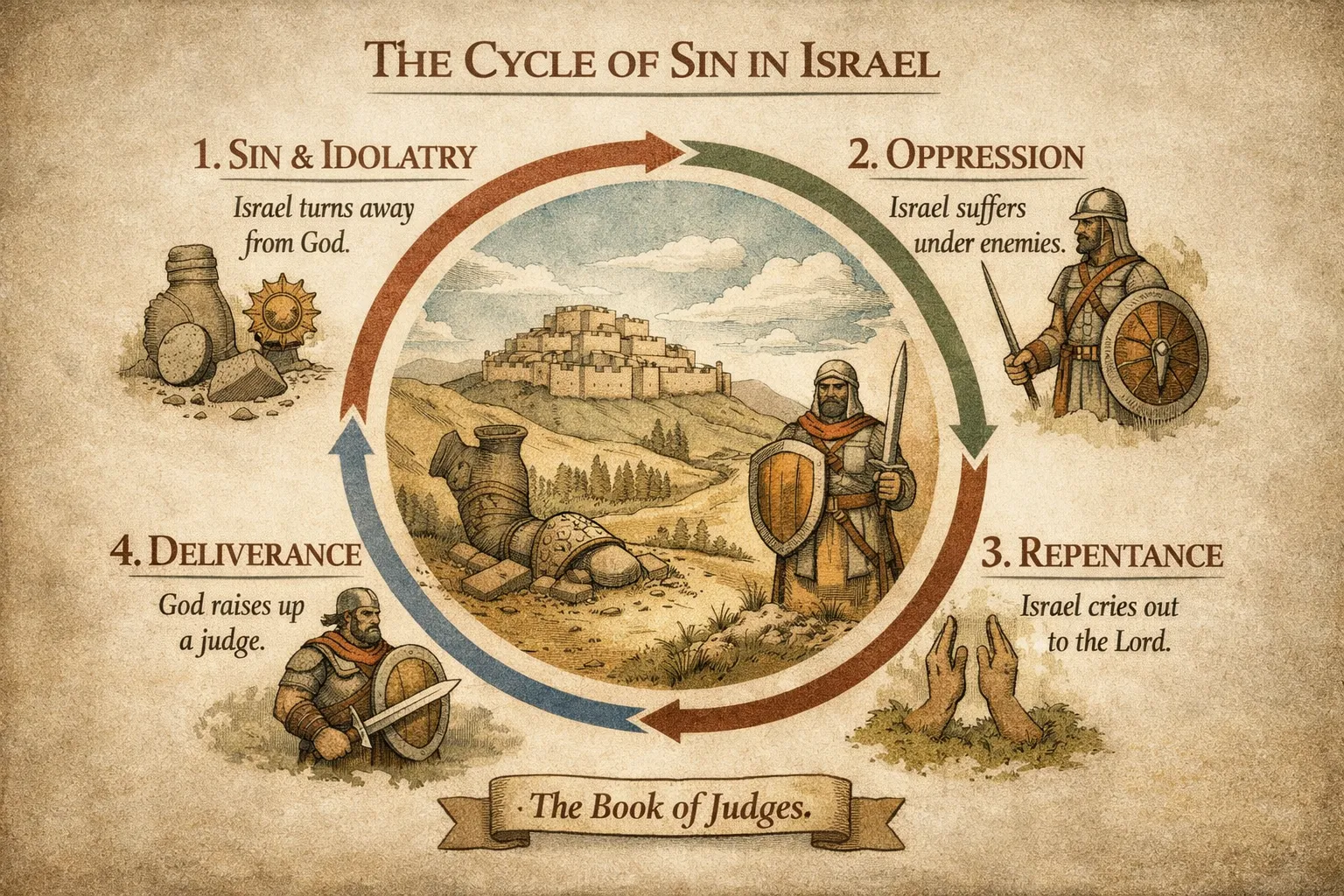
This pattern begins to fracture as Israel’s departure from the Lord deepens. Gideon delivers the people, who then seek to make him king. He refuses the title, yet still exercises authority in a way that anticipates the future monarchy. Even his ephod, first associated with worship, becomes a snare and hastens Israel’s descent into idolatry.
Gideon’s son Abimelech emerges as Israel’s first anti-judge. His short and violent reign reflects the absence of divine favor. Tola and Jair follow with comparatively long and stable rules, yet the narrative records no oppression, no enemy, and no deliverance. Jair, in particular, receives only two verses.
By the time we reach Jephthah, the cycle has not merely repeated but deteriorated. Israel’s disorder no longer needs external oppression to expose it. What follows is the natural outcome of a cycle hollowed out from within.
Jephthah Called to Lead
By the events of Judges 10:6, several observations can be made about Israel:
- They served multiple gods simultaneously.
- God explicitly declares that He will no longer deliver them.
- Israel removes its foreign gods.
- God relents, but without enthusiasm.
This marks the most strained divine-human interaction in Judges so far. God remains faithful to His covenant, yet Israel is spiritually bankrupt and incoherent.
Jephthah is not called in the manner of his predecessors. He is introduced as the son of a prostitute and is later driven out by his brothers. Scripture says he became the leader of “worthless men.” The text does not define this term in detail, but it does clearly assert that Jephthah gained a reputation as a capable warrior.
That reputation is what draws the elders of Gilead to him when the Ammonite threat intensifies. Notably, this appeal is not spiritual in nature. Jephthah is not asked to seek the Lord, to call Israel to repentance, or to intercede on their behalf.
Jephthah does not immediately accept their request. Rather than serving as a sword for hire, he negotiates. He bargains for authority and secures a promise that he will be made head over Gilead in exchange for victory over the Ammonites.
Sword and Spirit: The Conflict intensifies
The conflict does not remain isolated to Gilead. What begins as a regional crisis now carries consequences for Israel as a whole.
At this point in the narrative, the Spirit of the Lord comes upon Jephthah. This moment deserves careful attention. God’s sovereignty and mercy are both on display. Israel is not being governed at arm’s length through human intermediaries, but remains under the direct rule of the Lord Himself. The book of Judges repeatedly underscores this reality, often invoking the Angel of the LORD as God’s active presence among His people.
Fun Fact: 44% of the times The Angel of The LORD is mentioned are in the book of Judges.Yet Israel once again turns to human leadership for relief. The fullness of Christ’s identity has not yet been revealed, but the pattern is already visible. Israel continues to seek security in human authority rather than resting in God’s kingship. This moment anticipates the events of 1 Samuel, where Israel explicitly demands a king and is told that their request is not merely political, but theological.
"And the LORD said to Samuel, ‘Obey the voice of the people in all that they say to you, for they have not rejected you, but they have rejected me from being king over them."
What makes this moment so striking is not Israel’s failure alone, but God’s response. Despite Jephthah’s lowly origins, his shameful expulsion by his family, and the questionable circumstances of his rise to power, God still empowers him. Jephthah does not receive the Spirit because he deserves it, but because God is merciful. Does this pattern remind you of anything?
This sets the stage for what follows. Jephthah now stands at the intersection of sword and Spirit. Victory has been promised, yet fear remains. He is empowered by God, but does not understand God’s provision. He knows to invoke the Lord’s name, but not enough to rest in the Lord’s character.
Jephthah’s formative years matter here. Removed from Israel’s theological and covenantal center, his life was shaped by exile and survival rather than faithful instruction. He comes from a world where gods are appeased through sacrifice, not trusted through obedience. Those assumptions linger and cast a shadow, even as the Spirit of the Lord rests upon him.
From this divided posture, the vow emerges. In a moment of desperation, the narrative reaches its turning point. Jephthah seeks to secure what God has already promised, and learns the tragic cost of letting fear speak before trust.
The Vow
Jephthah’s intent is not difficult to discern. His vow seeks to secure victory and divine favor at any cost. It is conditional and transactional in nature, reckless in scope.
"And Jephthah made a vow to the LORD and said, “If you will give the Ammonites into my hand, then whatever comes out from the doors of my house to meet me when I return in peace from the Ammonites shall be the LORD's, and I will offer it up for a burnt offering."
The vow reveals urgency and fear more than devotion. It is not shaped by wisdom or instruction. It is spoken under the pressure of impending conflict by a man who believes victory must be secured rather than received. The narrative now forces us to confront several uncomfortable questions.
Who would have been in the house?
A natural reading of the text leaves little ambiguity. In a period Israelite household, the first to emerge in celebration of a returning warrior would almost certainly have been a person. Livestock were not kept within the living quarters of a home, nor would animals be expected to rush out in celebration. We can say with near certainty that there was not a border collie waiting at the door for his master’s return.
Given Jephthah’s circumstances, it is difficult to imagine that he did not understand a human being, and very likely his daughter, would be the one to meet him.
Why That of All Things?
The form of the vow matters. Jephthah does not promise obedience, reform, or renewed faithfulness. He commits himself to an act with absolute scope and unknown cost. This choice reveals how he understands faithfulness itself.
One of the challenges of reading the Old Testament with a completed canon is our distance from the story. We know how God has revealed Himself and how the narrative ends. From that vantage point, Israel’s errors can appear obvious. Jephthah did not possess that clarity. He lived within the fragmentation of late Judges, where memory of God’s acts remained, while confidence in God’s character had eroded.
Jephthah’s vow does not emerge from rebellion or indifference. It arises from a sincere but distorted attempt to act faithfully under pressure. He confuses spiritual strength and divine favor with intensity of commitment. Obedience gives way to demonstration. This mistake is not unique to Judges.
Rather than asking, “What has the Lord commanded me to do?” Jephthah shifts to a different question: “How can I prove that I am serious?” The Spirit of the Lord has already come upon him, and deliverance is already underway. His thinking reveals a man who believes God’s favor must be reinforced by his own resolve, even after God has acted in mercy.
His Only Daughter
Our concerns are quickly and regretfully confirmed. The first person to emerge from Jephthah’s house is his daughter.
"When Jephthah came to his home at Mizpah. And behold, his daughter came out to meet him with tambourines and with dances. She was his only child; besides her he had neither son nor daughter. And as soon as he saw her, he tore his clothes and said, "Alas, my daughter! You have brought me very low, and you have become the cause of great trouble to me. For I have opened my mouth to the Lord, and I cannot take back my vow.""
His only daughter. The narrator lingers here for a reason. She is his sole child, the end of his line, the bearer of his name and future. What confronts Jephthah is not only the loss of a loved one, but the collapse of his inheritance and hope.
The daughter herself remains largely silent. She does not argue or appeal to the Law. Her response is marked by submission shaped by loyalty and communal expectations. In this way, she mirrors Israel as a whole, becoming an innocent casualty of a leadership culture in decline.
What Did He Believe Would Happen?
Scripture does not tell us what Jephthah expected. The text leaves us with unresolved tension, and that silence is deliberate. We are not given his inner reasoning or his private hopes. Whether he assumed someone else would emerge, expected divine intervention, or simply failed to think through the weight of his words, the narrative refuses to soften the moment.
I believe we can safely say that the vow was spoken without wisdom. Jephthah commits himself before considering its cost. His words outrun his theology. There is no indication that God demanded such a vow or approved it. The responsibility for what follows rests squarely with Jephthah.
Death or Dedication?
The text records the fulfillment of the vow with remarkable restraint. After two months, Jephthah’s daughter returns, and he does to her “according to his vow”. Tradition has long been divided. Many understand this as literal human sacrifice. Others argue she was devoted to lifelong service, emphasizing the repeated focus on her virginity.
The text does not resolve the tension. It refuses to describe the act in detail, and it offers no moral commentary. What remains clear is that the vow governs the outcome. Whatever one concludes about the specifics, the narrative insists that this tragedy flows from Jephthah’s words, not from a command of God.
Did Jephthah Know the Law?
This is where the story again presses hard. Earlier in the chapter, Jephthah demonstrates detailed knowledge of Israel’s history. He recounts the nation’s journey, its conflicts, and its innocence in the dispute with Ammon. He speaks like a man who knows the covenant story well.
And yet, his actions suggest confusion about the covenant law. Human sacrifice is repeatedly condemned in the Torah. Child sacrifice, in particular, is presented as one of the defining evils separating Israel from the surrounding nations. The God of Israel is not like the gods Jephthah would have encountered in exile. He does not require appeasement through human blood.
This tension suggests that Jephthah knew Israel’s history but did not fully trust Israel’s God. Knowledge of what God has done does not always translate into discernment in what God desires.
The Law’s Forgotten Provision
The Law anticipated human weakness. It accounted for rash speech and foolish vows. It provided a way forward through confession and offering when a vow led toward sin. Obedience included repentance, not stubborn consistency. God always seeks to restore us to repentance.
"If anyone utters with his lips a rash oath to do evil or to do good, any sort of rash oath that people swear, and it is hidden from him, when he comes to know it, and he realizes his guilt... he shall bring to the LORD as his compensation for the sin that he has committed a female from the flock, a lamb or a goat, for a sin offering. And the priest shall make atonement for him for his sin."
Jephthah’s tragedy is sharpened here. He was not trapped. The Law provided a path of mercy. Whether through ignorance or distrust, he did not take it.
Conclusion
“In those days there was no king in Israel. Everyone did what was right in his own eyes.”
Judges ends with this refrain because it names something deeper than political chaos. It describes a people whose theological vision had collapsed inward, shaped more by fear and instinct than by the Law they had been given. The language of covenant remained, but the confidence that should have accompanied it did not.
Jephthah’s story exposes what happens when that confidence weakens. He was empowered by the Spirit. Victory was already secured. Yet he spoke from anxiety rather than rest, and bound himself to words he had not carefully considered. His vow reflects a man caught between worlds, aware that God acts, but uncertain how to live faithfully before Him. The cost of that uncertainty did not end with him.
Scripture later gathers this condition into the Lord’s own words, spoken to Israel as a whole:
"Oh, that my people would listen to me, that Israel would walk in my ways"
Those words still meet us where we are.
"For he is our God, and we are the people of his pasture, and the sheep of his hand. Today, if you hear his voice,"
Judges records what happened when Israel stopped listening. Jephthah’s vow stands as a warning, preserved in Scripture not to celebrate his zeal, but to show us where rash words lead when they are spoken before a faithful God we do not fully trust.